

👉 This post is a bit long, you may want to see it directly in the browser! 🙏
97% of day traders lose money long-term.
Every single one of them believed they were skilled. They watched a few YouTube tutorials, nailed two trades in a row, and concluded they’d cracked the market. Then they blew up their accounts faster than you can say “leveraged long.”
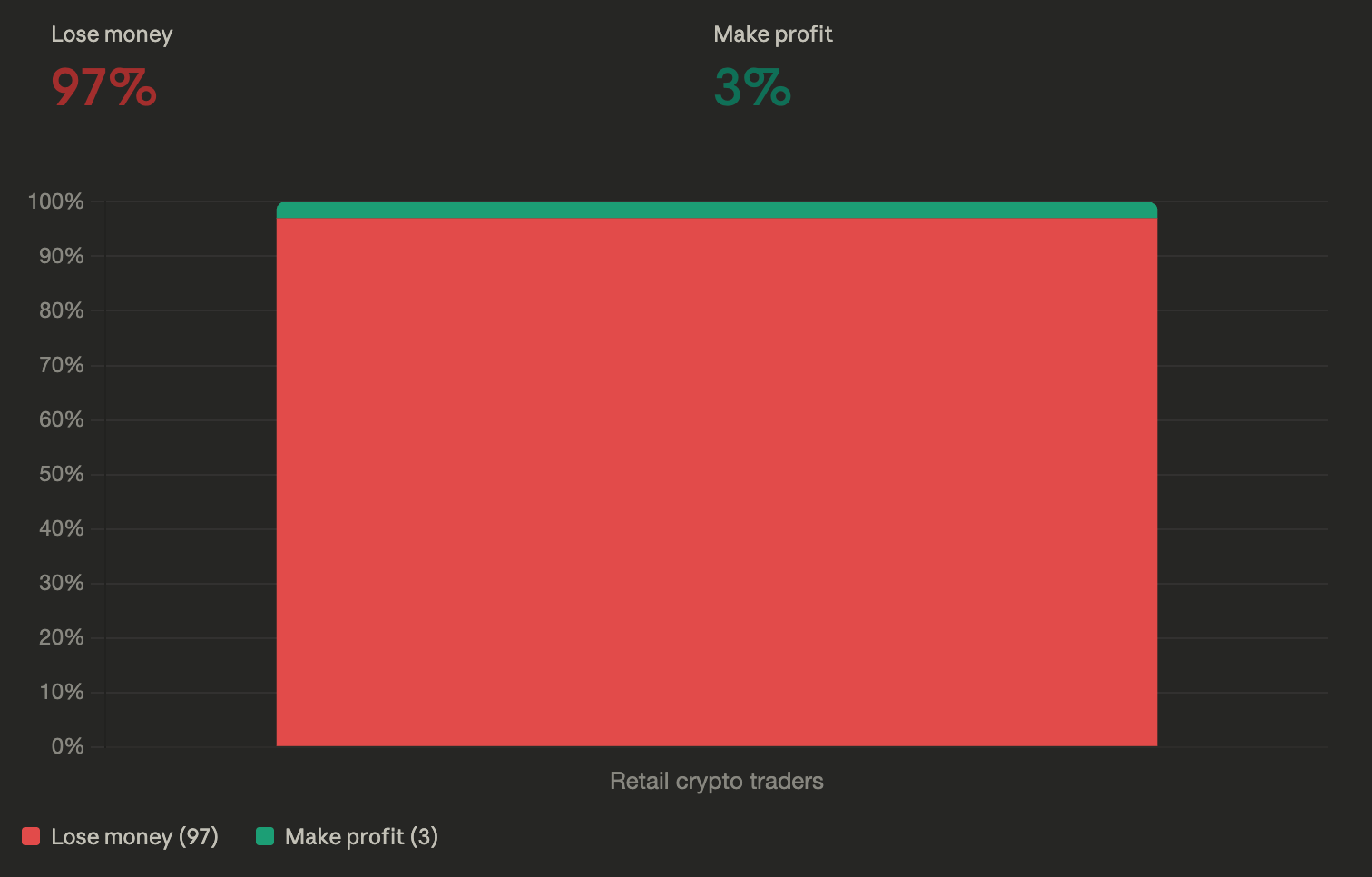
A few things worth knowing about this statistic: the 97% figure comes from studies of retail traders, The losses aren’t evenly distributed either - many of the 97% lose far more than the 3% gain, because the winners are often institutions, algorithms, or early holders with structural advantages.
This isn’t just about trading though. It’s about how most people misread success in EVERY SINGLE DOMAIN - business, career, investing, health. Someone gets a lucky break and builds an entire identity around a streak that was statistically inevitable for someone. Just not repeatable for them.
So let’s break it down.
When you think about beating the market, do you wonder who will you compete with?
Professional Wall Street investors
Insiders
Institutions
Early Holders
Project’s Developers
Algorithms and advanced bot alerts.
This looks so unfair, it’s hard even to articulate. Still, people think they can be smarter after watching a few videos on youtube. And the funny thing is, it works out for someone, sometimes, and every here and there for someone else - just because of how probability works.
Here’s the core truth most people refuse to accept:
Variance hides skill in the short run and reveals it in the long run.
Short-term results are noisy. Long-term results are brutally honest. And the difference between the two is where fortunes are made - and lost.
I touched on this idea briefly in Life Is a Badly Designed Game (Section 3: Skill > Luck Over Time). Today, we’re going deep.
The Luck-Skill Spectrum
Not everything in life sits neatly on one side. Most activities are a blend of skill and luck - the question is how much of each.
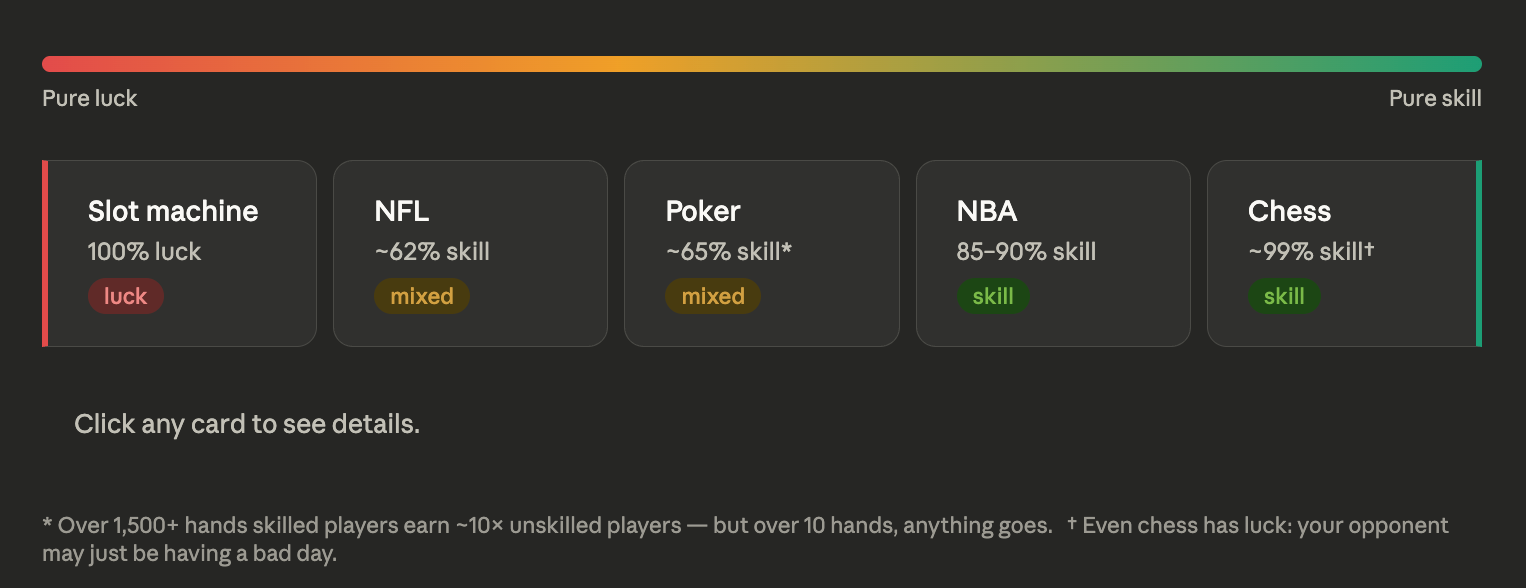
Michael Mauboussin, in The Success Equation, built a framework for exactly this. He mapped activities on a continuum from pure luck (slot machines) to pure skill (chess). Most of life sits somewhere in the messy middle.
Disclaimer: Even Chess requires luck. Your opponent may have just a bad day.
Sports data makes this tangible:
NBA outcomes are 85-90% explained by skill. The best teams almost always win.
NFL outcomes are roughly 62% skill. Any given Sunday, a mediocre team can beat a great one. But over a full season? Talent rises.
Poker, over 1,500+ hands, shows skilled players earning roughly 10x what unskilled players earn. Over 10 hands? Anything goes.
Kahneman nailed it: ”A good process will usually have a good outcome, but only over longer periods of time.”
There’s also a paradox here that most people miss. As the average skill level in a field rises, luck explains more of the difference between winners in the short term. When everyone is good, the margins shrink and randomness fills the gap.
But if you zoom out?
The compounding effect of even tiny skill edges becomes overwhelming.
The Math - Why Time Is the Great Separator
It’s a shame that most people do not understand statistics, but because of that we’ve great advantage.
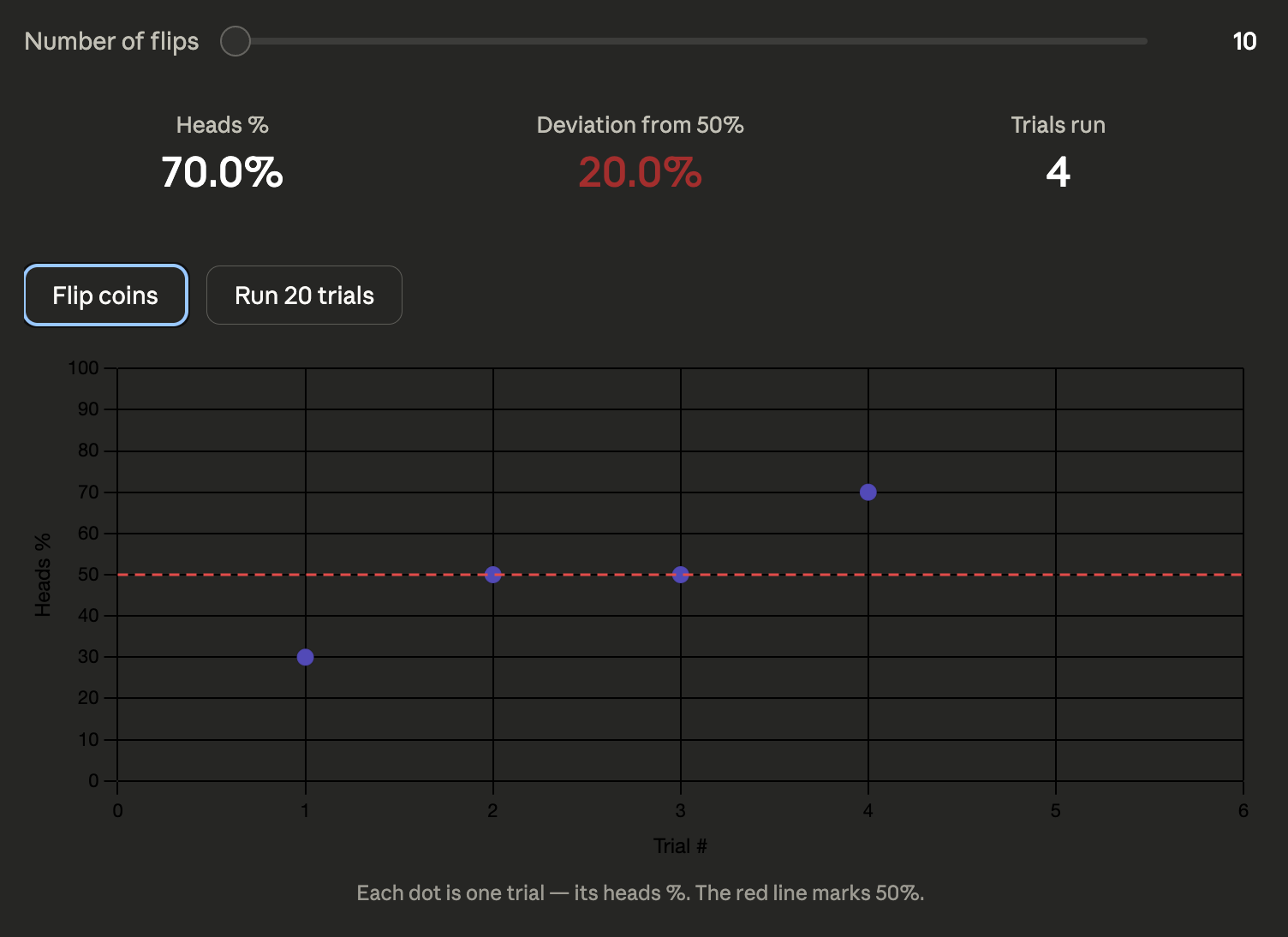
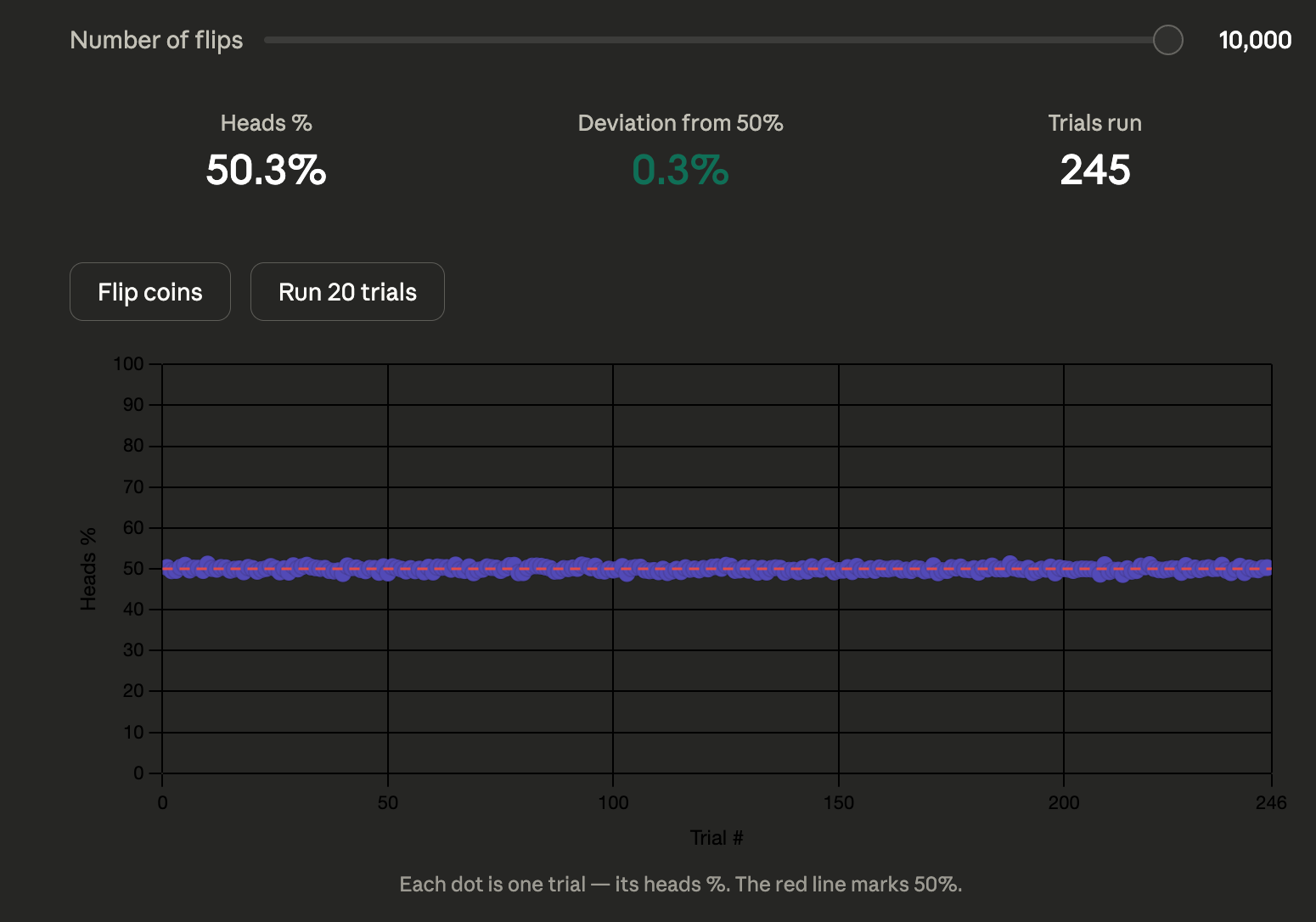
The Law of Large Numbers states that as the number of trials increases, average outcomes converge to the expected value. Variance shrinks toward zero.
In plain English: flip a coin 10 times - you might get 8 heads. Below each dot represents 10 coin flips run.
Flip it 10,000 times - you’ll land very close to 50/50. The same principle applies to skill expression in any domain. Below, you can see each dot representing 10k flips, and how final result deviates from 50%.
One quarter of great investment returns could easily be luck.
A hot streak in business - maybe the market was just favorable.
But 10 consecutive years of outperformance? The probability of that happening by chance alone approaches zero.
This is the mathematical backbone of the entire argument. Time doesn’t just reveal skill - it demands it. Every additional trial strips away another layer of noise and leaves you standing naked with your actual ability.
The coin doesn’t care about your confidence. Neither does the market.
Who else earns on markets?
At the start of this article I’ve shown you who you’ll compete with when you choose the market trading path:
Professional Wall Street investors
Insiders
Institutions
Early Holders
Project’s Developers
Algorithms and advanced bot alerts.
But the funny thing is, even from those groups, a lot of people still lose their money over time.
So WHO actually earns?
The research shows, that those, who do... nothing.
Literally. The best-performing accounts tend to belong to people who forgot they had them. There’s a famous story about a Fidelity internal study that found their top-performing accounts belonged to dead people or people who forgot they had an account. The story itself is almost certainly an urban legend - no one has ever found the original source. But the principle behind it? Backed by mountains of data.
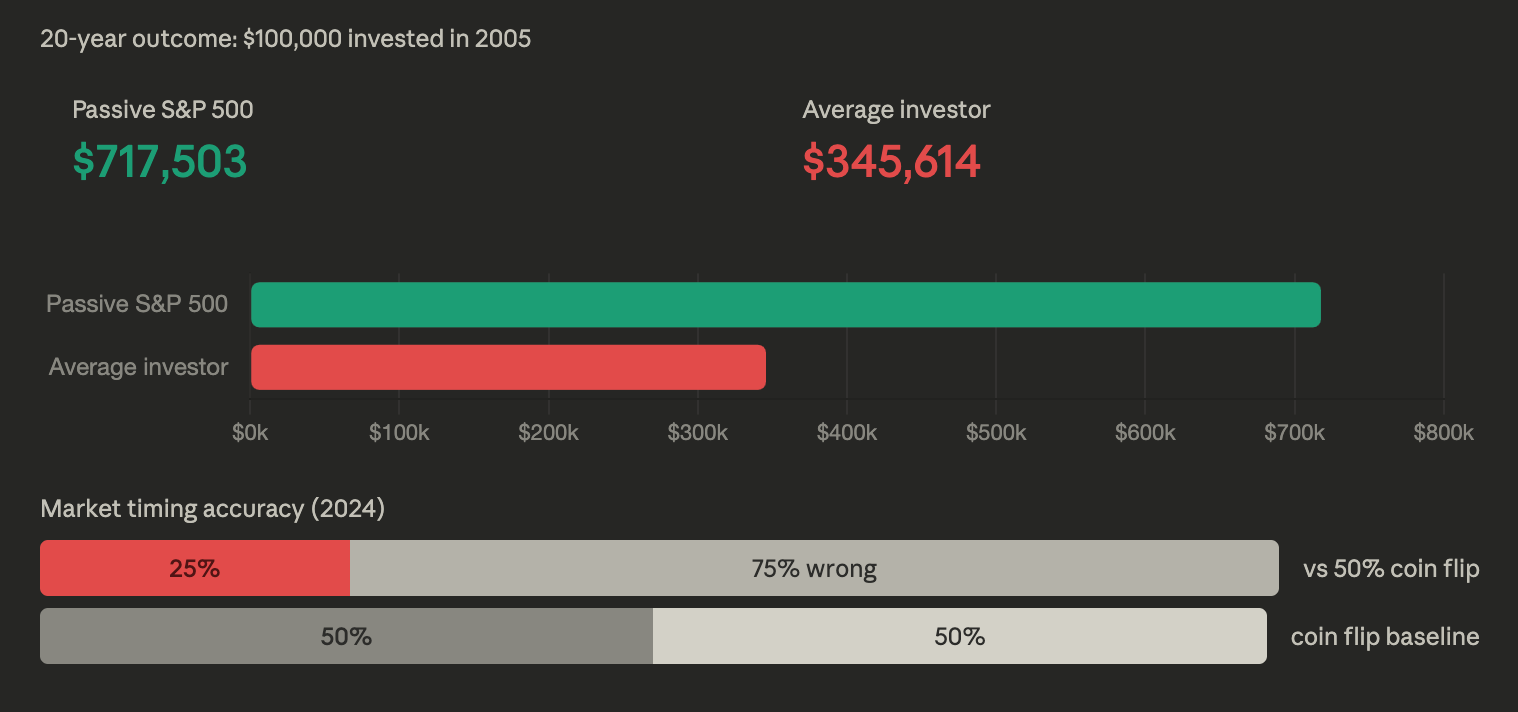
DALBAR has been tracking investor behavior since 1994. Their 2025 report found that in 2024, the average equity investor earned 16.54% while the S&P 500 returned 25.02% - an 8.5 percentage point gap. Over 20 years, a passive $100K in the S&P 500 grew to $717,503. The average investor’s behavior reduced that to $345,614. Investors correctly timed the market direction only 25% of the time - worse than a coin flip.
Here’s an even more telling finding. Studies consistently show that women outperform men as investors - by 0.4% to 1.8% annually depending on the study. Fidelity analyzed 5.2 million accounts over a decade and confirmed it. Warwick Business School found the same with Barclays data.
The reason? Women trade about half as often.
Not better stock picks, no insider knowledge. Just... less activity. Less overconfidence.
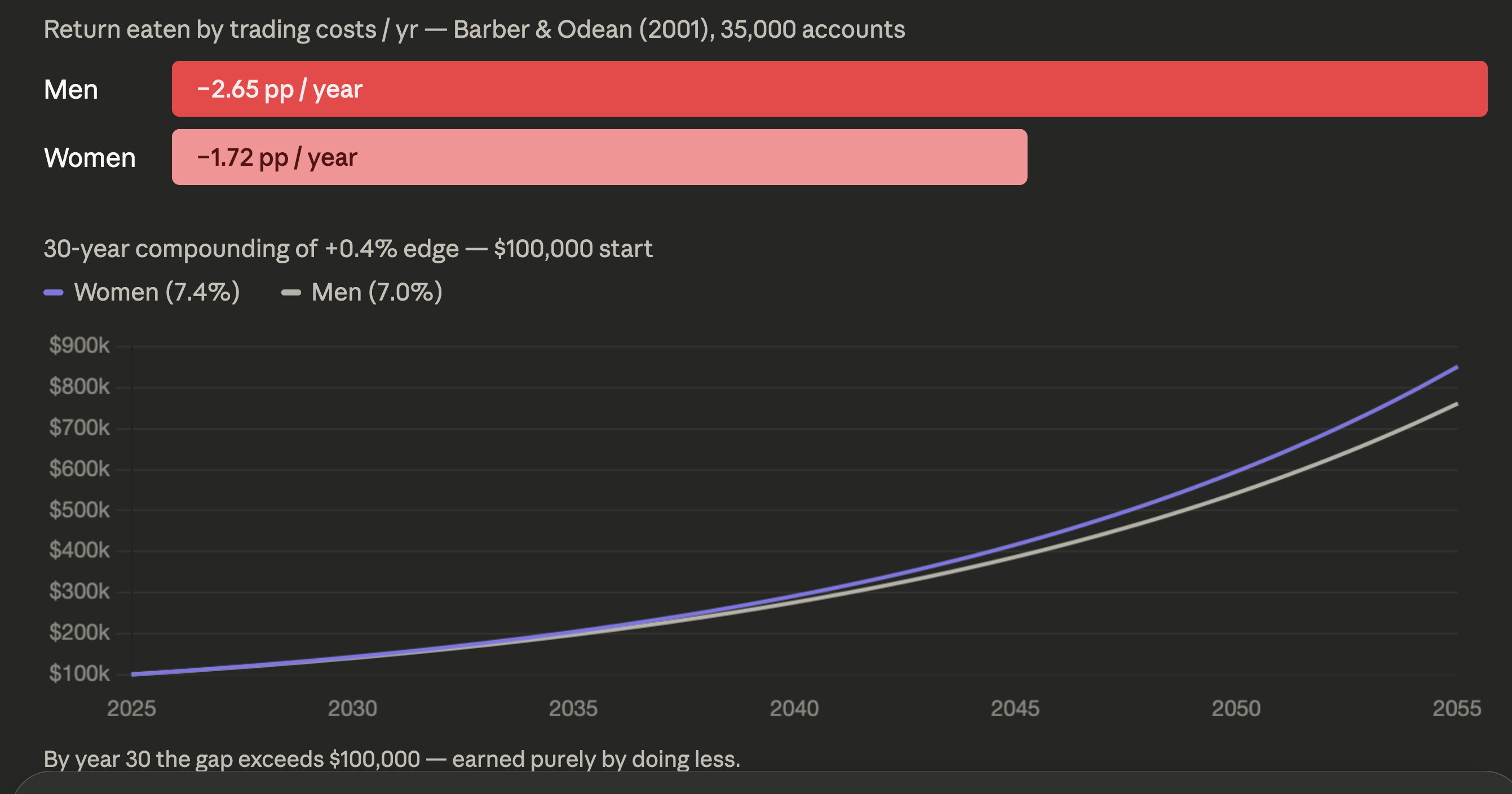
In the curve above, it almost perfectly reflects the profit eaten by the trading cost. The consequence is, that nearly 1 full percentage point less eaten by friction annually. And the compound curve shows what that quietly adds up to over 30 years - over $100,000, generated entirely by restraint.
As Jack Bogle — the man who created index investing - put it:
“Don’t do something, just stand there!”
The mechanism is brutally simple: overconfidence → more trading → more costs and bad timing → worse returns. It works the same way whether you’re a retail trader, a hedge fund manager, or a crypto degen. The more you touch it, the more you break it.
And before the crypto crowd says “but HODL works” - yes, for Bitcoin. For the average altcoin? A study running 480 million simulations found the median HODL return was -28.4% after fees. The spectacular wins you see on Twitter are survivorship bias. For every guy who forgot about his Bitcoin and woke up a millionaire, thousands of others forgot about their altcoins and woke up with nothing.
The people who actually build wealth in markets aren’t the ones making clever moves. They’re the ones who stopped making moves altogether.
The Graveyard of Lucky Gamblers
Let’s look at where luck-dependent strategies end up.
Crypto traders: 95-98% lose money long-term. They all believe they’re skilled and smart, yet they lose life savings without understanding the math of probability. Every now and then one person gets lucky, earns tons of money, and the masses confuse that with mastery.
They completely ignore the fact that someone will always win by pure chance. That’s how probability works. If a million people flip coins, someone will get 20 heads in a row. Then they’ll start a Discord and sell a course about it.
Day traders broadly: Only 1-3% consistently beat the market. Active traders underperform passive investors by 6.5% annually. That’s not a rounding error - that’s the cost of confusing activity with skill.
Mutual fund managers - the supposed professionals: Only about 15% maintain their outperformance over 14 years. The rest regress to the mean, which is a polite way of saying they got lucky and then they didn’t.
Now here’s a comparison that hits close to home. I follow these two figures in the Polish investing/trading space: Cezary Głuch and Rafał Zaorski.
Trader21 aims for steady wealth growth. Disciplined. Methodical. Boring, if you’re the kind of person who needs adrenaline with their morning coffee.
Zaorski? He generates incredible profits. And incredible losses. He went broke multiple times. He gambled other people’s money, used extreme leverage, and was wrong more often than he was right.
As I noted when studying their approaches: ”I prefer calm, slow pace of steady increase of wealth, and I do not need to be the absolute best in the market to be satisfied.”
One strategy survives contact with time. The other survives contact with Twitter.
The Skill Builders Who Won
If time destroys lucky gamblers, it canonizes skilled practitioners. Let’s look at the evidence.
Warren Buffett beat the market in 28 out of 31 rolling periods - placing him in the 99.99th percentile. The probability of achieving this by luck alone is effectively zero. What looks like “magic” is 70+ years of compounding a genuine skill edge. He still lives in the same house he bought decades ago - because wealth built on skill doesn’t need to perform.
Annie Duke, professional poker player turned decision scientist, put it best: ”There are exactly two things that determine outcomes: luck and decision quality. Luck you can’t control. Decision quality you can.” She tells a story about Phil Ivey - one of the greatest poker players alive - who would obsess over suboptimal plays even after winning sessions. Because he understood that the outcome wasn’t the signal. The process was.
Alex Hormozi: ”Volume negates luck.” He points to Kobe Bryant, who did three practices a day while everyone else did one or two. In the beginning, Kobe was worse than his teammates. Then equal. Then better. Then untouchable. Because when you 3x your reps, you don’t just keep pace - you compound ahead. The gap becomes uncatchable.
Jim Collins, in Good to Great, found that the companies that went from good to great ”did not have a perfect track record. But on the whole, they made many more good decisions than bad ones.” Not perfection. Consistency. The Stockdale Paradox at work: retain faith that you will prevail, while confronting the brutal facts of your current reality.
Do you notice the pattern?
None of these people eliminated luck from their lives. They made it irrelevant through volume, consistency, and deliberate improvement.
The Real Skill - Staying in the Game
Here’s the uncomfortable truth that ties everything together:
Skill beats luck. But only if you don’t quit.
January 9th - that’s the day researchers found that 80% of people abandon their New Year goals. Nine days.
That’s how long most people’s “commitment” to change lasts.
On the X platform, only 0.05% of accounts have more than 1,000 followers. Not because growing an audience is impossible, but because it’s uncomfortable, unclear, and unglamorous in the early months.
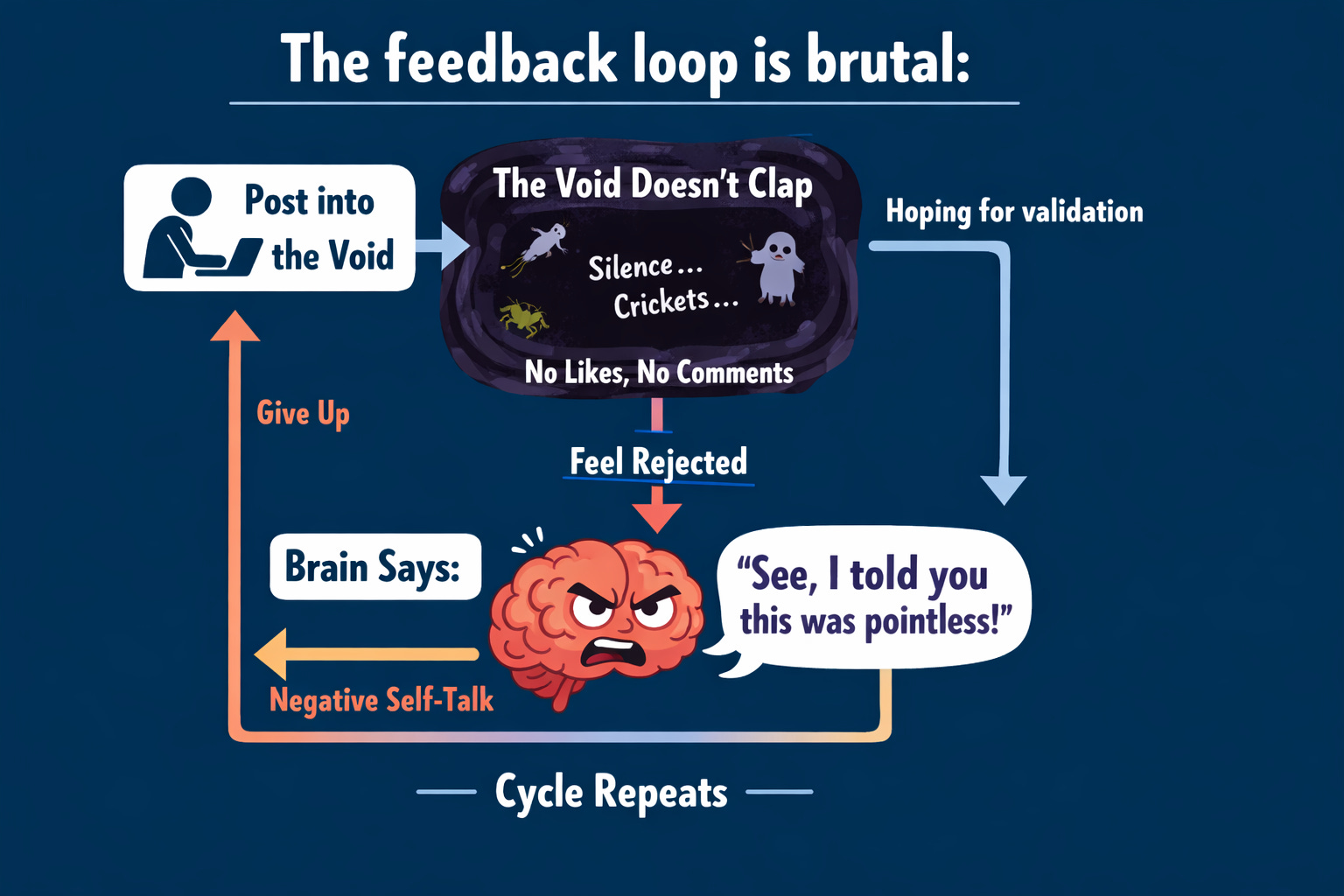
The feedback loop is brutal: you post into the void, the void doesn’t clap, and your brain says “see, I told you this was pointless.”
This is where the concept of deliberate practice matters.
Anders Ericsson’s research showed it’s not 10,000 hours of anything. It’s focused, feedback-driven improvement. Engineers understand this intuitively - it’s debugging your approach, not just writing more code. It’s reviewing why your last article flopped, not just publishing another one.
Angela Duckworth formalized something useful here:
Performance = Talent x Effort²
Effort shows up twice. First, effort builds skill. Then, skill multiplied by effort produces results. This is why consistent, mediocre-talented people routinely outperform brilliant people who dabble.
And then there’s the compound interest law, as Brian Tracy put it simply: ”If you invest money and allow them to grow using compound investment mechanism, you will get rich at some point. That’s all.”
That’s it. No secrets. No hacks. Just time + skill + not quitting.
As Phil Konieczny would say - don’t try to time the peaks and valleys. Average your way across multiple cycles, and it becomes very hard not to build wealth. People just think too short-term to see it.
The Honest Nuance
I’d be lying if I told you skill always wins. There are domains where luck still dominates, and pretending otherwise is its own form of delusion.
Low-sample domains - startups, entertainment, viral content - have enormous variance. You can do everything right and still fail because the sample size is too small for skill to express itself. One product launch. One movie. One tweet. These are closer to coin flips than chess matches.
Do that, quantity negates the luck, as Ycombinator stated: 2/368 investments, following the power law of profit distribution.
Black swan events exist. Nassim Taleb’s concept of antifragility is relevant here: some systems don’t just survive disorder - they benefit from it. Building optionality, keeping reserves, positioning yourself to gain from unexpected events - that IS a skill. Perhaps the most underrated one.
And there are real trade-offs you can’t escape. Time vs. money. Freedom vs. certainty. Growth vs. comfort. As I wrote in the newsletter framework: ”Adults accept trade-offs. Children look for hacks.”
You can’t optimize for everything simultaneously. The skill is knowing which trade-offs to accept - and accepting them without resentment.
Understand, which game you’re playing on.
The Question to Sit With
To win: work on the skills and use luck when it happens. Never depend on it.
The disciplined person’s move this week is boringly simple: pick one skill. Practice it deliberately. Measure your progress. Then repeat - not for a week, not for a month, but for years. Compounding is the core engine that powers everything, and long-term players always win.
Your skill set is the only asset that can’t be inflated away, can’t be seized, and appreciates with use rather than depreciating. As Paul Jarvis wrote in Company of One: ”You have to be good at your skill set before you can expect to achieve autonomy from using it.”
So here’s the question I’ll leave you with:
Are you building skill - or just hoping your lucky streak holds?
Great read man! Packed with value