

Somewhere in March, without anyone announcing it, the Claude.ai usage curve turned a corner.
Anthropic’s Economic Index dropped quietly that month - the kind of research paper that ends up in industry decks six weeks later once someone figures out what it actually says. I’ve been sitting with it for a couple of weeks. I think it’s the most important number I’ve read this year.
revenue as a working engineer. Numbers are real and posted publicly every
week
Here’s the number: 0.92.
That’s the correlation between prompt quality and productivity outcome, holding tool use constant. In plainer English: once two developers are using the same model, the single variable that explains whether they ship in a day or a week is how they write the prompt.
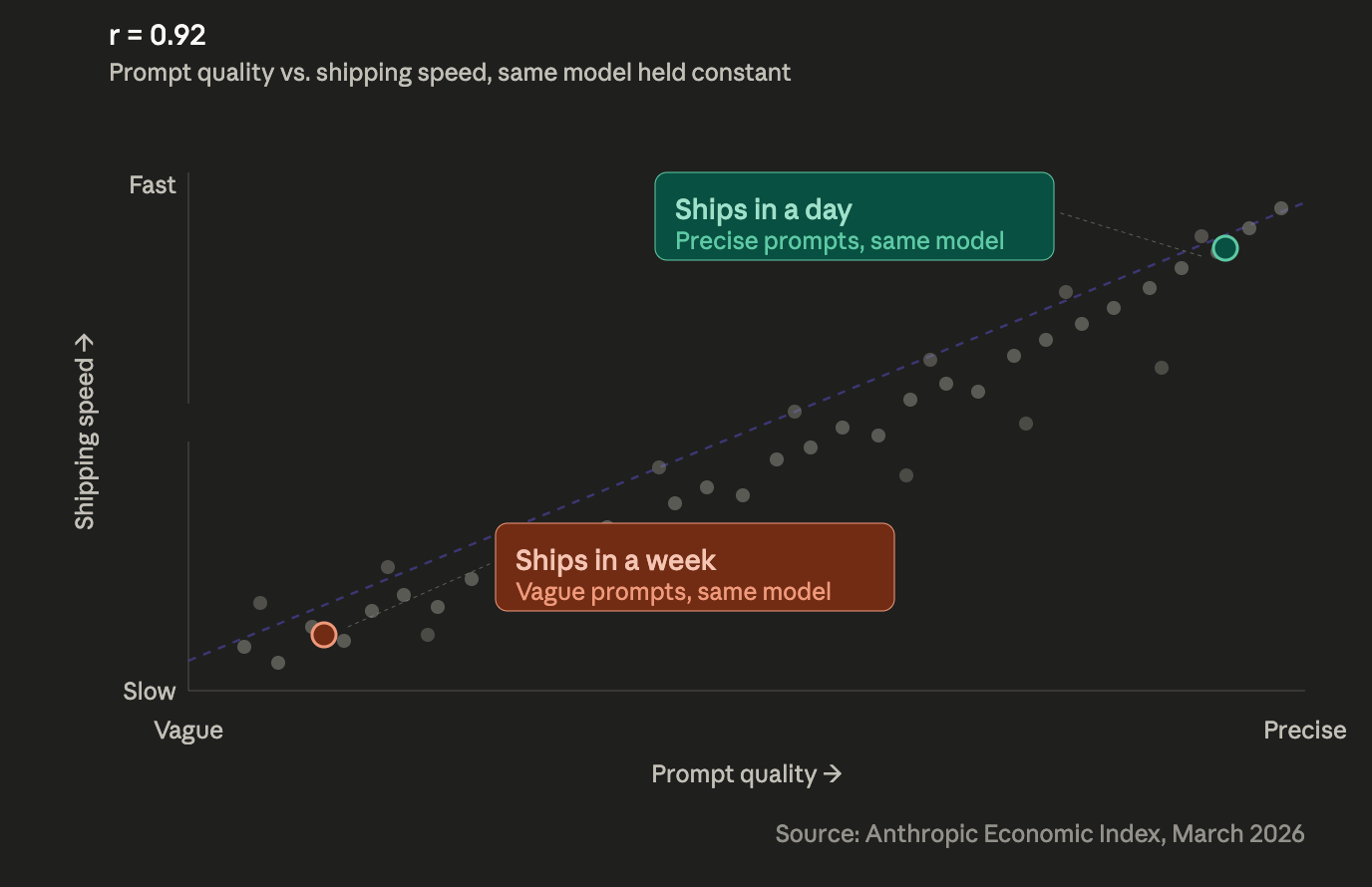
Not their typing speed. Not their framework. Not their prior experience. The prompt.
I’ll come back to that. First the part that made me actually close my laptop and stare at the wall.
Augmentation Mode
52% of Claude.ai users are now in “augmentation” mode.
Last year the headline use case was task delegation - write this function, draft this email, summarize this document. You told the model what to do, it did the thing, you checked and shipped.
This year, more than half of Claude.ai sessions are conversational. Back-and-forth. Thinking-with. The user is not handing off a task; they’re using the model as a second brain that talks back.
That sounds small. It isn’t. It’s a different product being used by different people for a different reason.
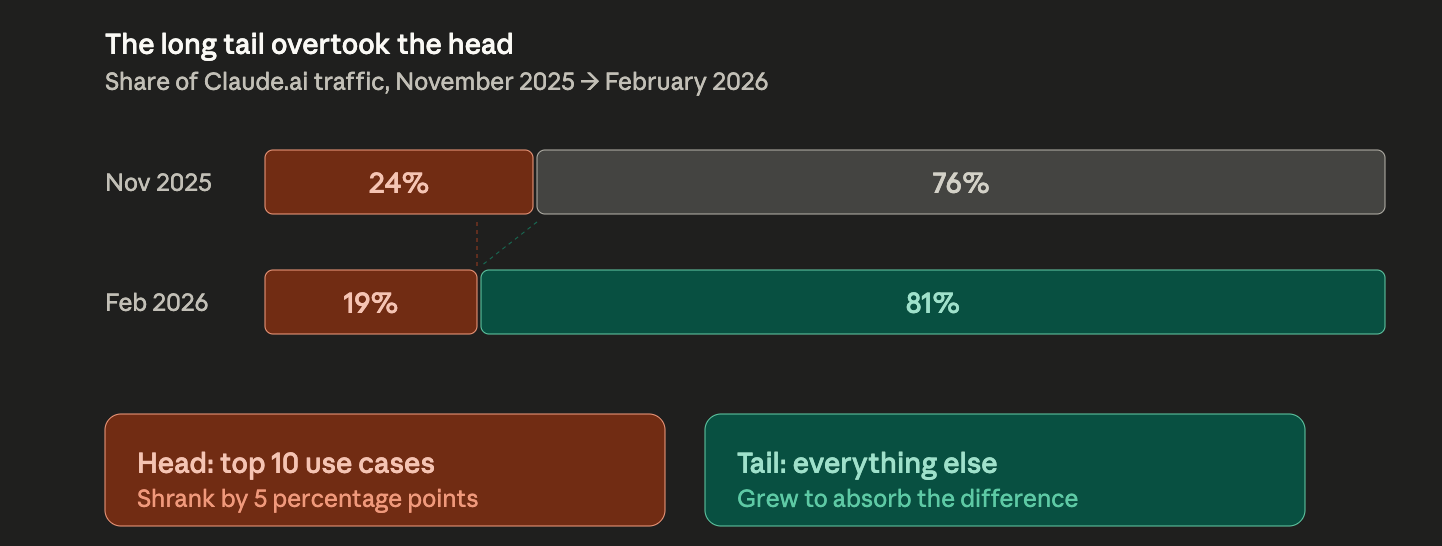
The sign this has really shifted is quieter: the top 10 use cases dropped from 24% of all traffic to 19%. That doesn’t sound like much. It means the tail of “what people use this for” has exploded. The long tail is now bigger than the head. People are using Claude for things nobody thought to optimize for.
Coding is still about 35% of conversations - that’s held steady - but inside coding the texture has changed. Less “write me this function.” More “I’m stuck on this architecture, let me walk you through what I’m seeing and you tell me where I’m wrong.”
The 12x number and why it’s the honest one.
Anthropic reports that college-level tasks now complete roughly 12x faster
than a year ago. High-school-level tasks, 9x.
I want to be careful about this. A lot of AI productivity claims dissolve on contact with a working engineer’s actual week. But 12x on a cohort of measurable cognitive tasks, controlled for model version - that’s not a vibe. That’s compression.
A week becomes an afternoon.
An afternoon becomes an hour.
The METR study last year said developers with AI were 19% slower than developers without. That was the contrarian stat of 2025. Same cohort, recut this year: 18% faster. Same developers, same tools. What changed is how they were using them.
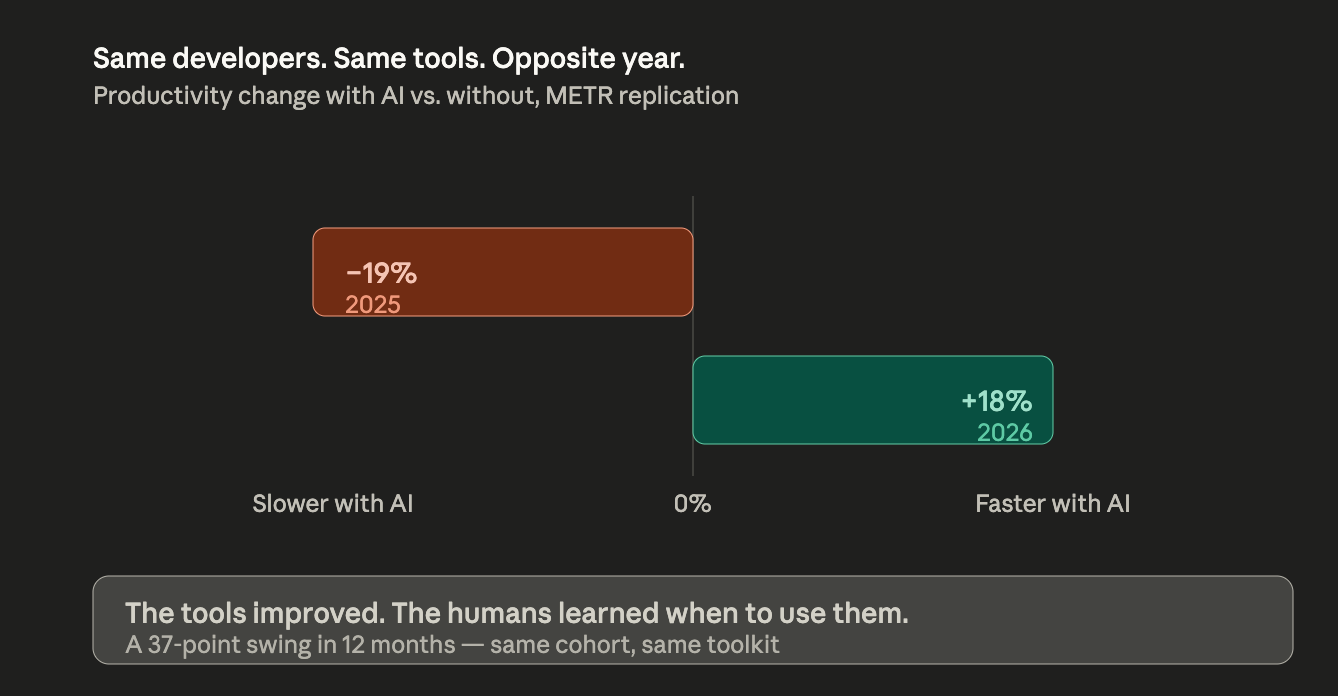
That’s the 0.92 number showing up in the field. The people who got good at prompting compounded. The people who didn’t stayed where they were - or got worse, because they stopped trusting their own instincts and started trusting someone else’s autocomplete.
The trap.
Here’s where I have to be honest about where I’ve been. I spent most of 2024 treating AI like autocomplete. Good and fast autocomplete. But autocomplete - which is to say, I gave it small local tasks and verified the output the way you’d review a capable junior’s PR. Only in 2025 it had changed.
The problem with that workflow isn’t that it’s wrong. It’s that it doesn’t scale to the conversations 52% of users are now having. Autocomplete is a one-shot transaction. Augmentation is a dialogue. Those are different skills.
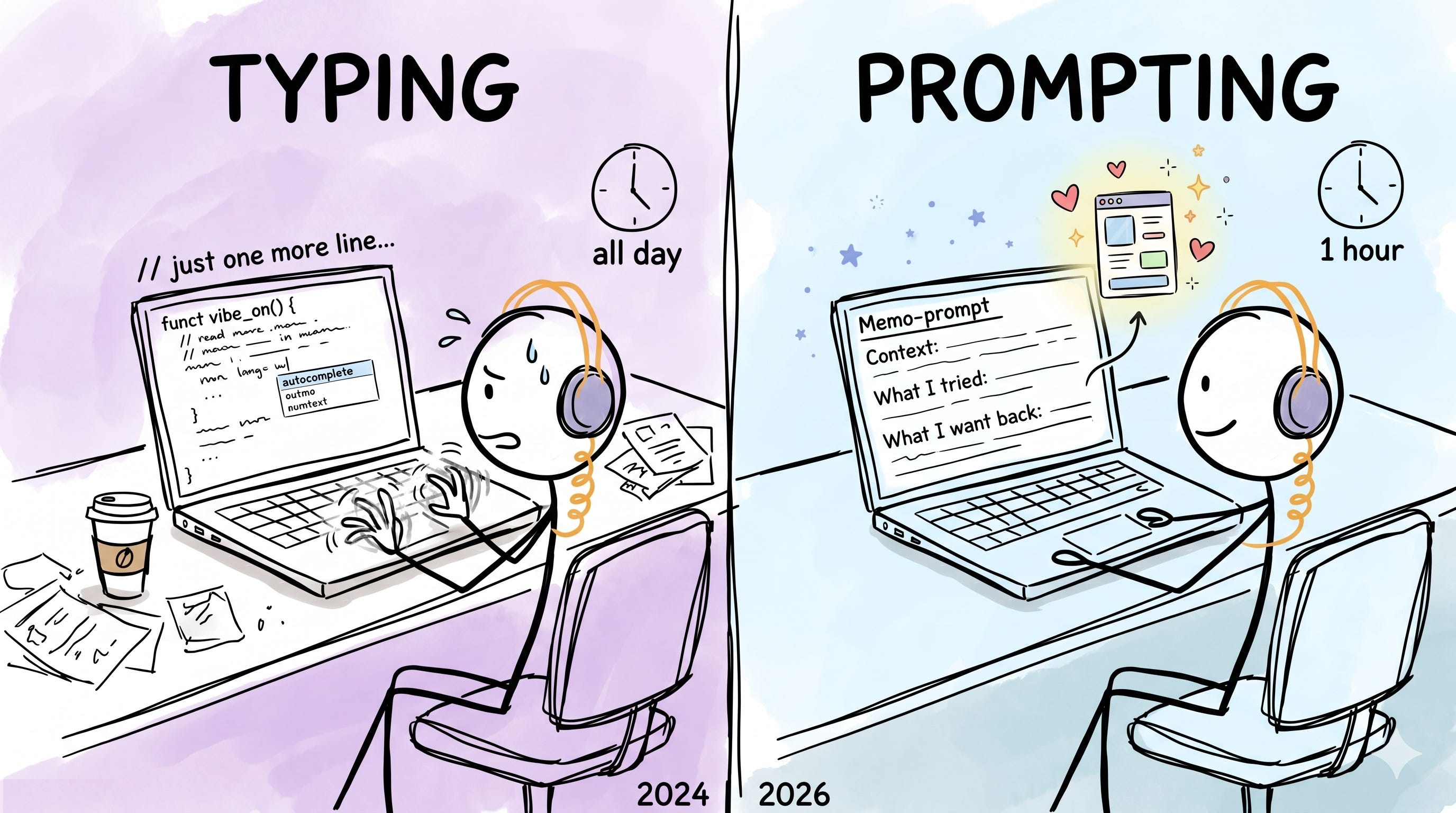
Writing a good prompt, I’ve come to believe, is closer to writing a good memo than to writing a good search query. It has:
A problem statement, in the words I’d use to a smart colleague who just walked into the room.
The context they’d need to make a judgment call, not follow a narrow instruction.
What I’ve already tried and ruled out.
What I specifically want back, and in what form.
When I write prompts like that, the 0.92 number shows up in my own week. When I don’t - I get exactly what I asked for, at high quality, and it turns out I was asking the wrong thing.
That last line is the whole game in 2026.
What this means for the developer who ships.
If you are a developer reading this in April 2026, you are in one of three
places.
Place one: you still treat the model as autocomplete.
Your ceiling is about a 2x productivity gain. That’s fine. That’s also where most of the industry was in early 2025, which means it’s where the value got priced already.
Place two: you treat the model as a pair.
You think out loud to it. You argue with it. You hand it 3x more context than feels necessary and you read its responses like you’d read a smart colleague’s memo. Your ceiling is the 12x cohort.
Place three: you’re using the model to ship businesses, not just code.
Product decisions, pricing, copy, support scripts, positioning. You’re not a better coder. You’re a one-person company.
Place three is the Indie Hacker Renaissance I wrote about Friday. Place two is what the DORA report found in mature teams. Place one is most of tech, and it’s the seat that gets squeezed between the other two as the year goes on.
Moving between these places is not a skill ceiling. It’s a habit change. It’s how you start a conversation with the model on Monday morning.
Where I am.
I’m writing this week-one of a Substack relaunch, with $6 of online product revenue for the year. I’m not in place three yet, even though I have systems setup for myself. I’m climbing from place two to place three in public, with audit numbers posted every week.
Part of what I’ve been building - quietly, mostly on weekends - is the prompt library I wish I’d had in 2025. Not a list of “10 ChatGPT prompts for developers.” The actual prompts I use to take a product idea from “I’d build that” to “someone paid for it.”
Pricing conversations with the model.
Positioning dialogues.
Launch day orchestration.
That’s the Ship & Sell Kit.
It launches Next week. Founding price $29 for the first 50 seats. The waitlist is this Substack - if you’re reading this, you’re on it.
I’m pricing it deliberately low because the point this quarter is not revenue. The point is feedback from the first cohort while I still remember what it was like in place one.
One thing to watch this week.
Stripe Sessions 2026 is in San Francisco April 29–30. The expected reveal is Managed Payments going generally available. If you’re past $5K MRR and still on the old Connect flow, that announcement is going to change your architecture diagram.
I’ll cover it on Wednesday.
Until then:
write your prompts like memos.
Argue with the model.
The 0.92 isn’t a ceiling. It’s an invitation.
The Engineer of Wealth is a weekly transparency report on building online
revenue as a working engineer. Numbers are real and posted publicly every
week.